

The 3 best home charging stations for electric cars
Charging at home is often the "sweet spot" for electric cars: more convenient, usually cheaper per kWh, and with complete control over charging times. In this guide, I recommend my three favorite models (Wallbox Pulsar Plus, Tesla Wall Connector, and Schneider EVlink Home), and explain how to use them. when it suits each one, And what to look for before buying so you don't make a mistake.

Quick summary: which one to choose in 30 seconds
Wallbox Pulsar PlusThe most balanced option for most users: compact, with a good app, scheduling, power management, and a very complete ecosystem. Supports 7.4 / 11 / 22 kW depending on the version.
Tesla Wall Connector: ideal if you are looking for simplicity and power (up to 22 kW three-phase in Europe), very good value for money and compatibility with Type 2.
Schneider EVlink Home: domestic “tank”: robust, geared towards durability and electrical reliability, with 7.4 kW (single-phase) and 11 kW (three-phase) versions very common in homes.

Wallbox Pulsar Plus (recommended): the most balanced for home
Why it's the most recommended: It's the home wallbox that best fits the widest range of situations: compact size, app/portal ecosystem, and typical features that are actually used (schedules, power control, etc.). In European versions, it reaches... 7.4 kW (1 phase), 11 kW (3 phase) or 22 kW (3 phase) according to the model.
Data:
Power: 7.4 / 11 / 22 kW (depending on version).
ConnectorType 2 (in Europe).
Format: very compact (approx. 166 × 163 × 82 mm).
Security: includes AC 30 mA and DC 6 mA residual current detection (RDC-DD); however, external protection depends on local regulations/installation.
Connectivity / Integration: OCPP compatible (according to technical data sheet) and management functions.
Real advantages:
Very good for schedule times (for example, charging in the early morning with off-peak rates).
They usually exist more familiar installers with Wallbox.
A good balance between "smart" and ease of use.
When to choose it
You want a home solution "for everything": today you charge normally, tomorrow you switch to a time-sensitive tariff, the day after you install photovoltaics, or you are interested in controlling consumption.
You care about a full app experience and features without getting bogged down by "industrial" brands.
When NOT to choose it
If you want something ultra-simple without an app or features (or you don't care about programming/monitoring).
If your priority #1 is "as robust as possible" over design and app.
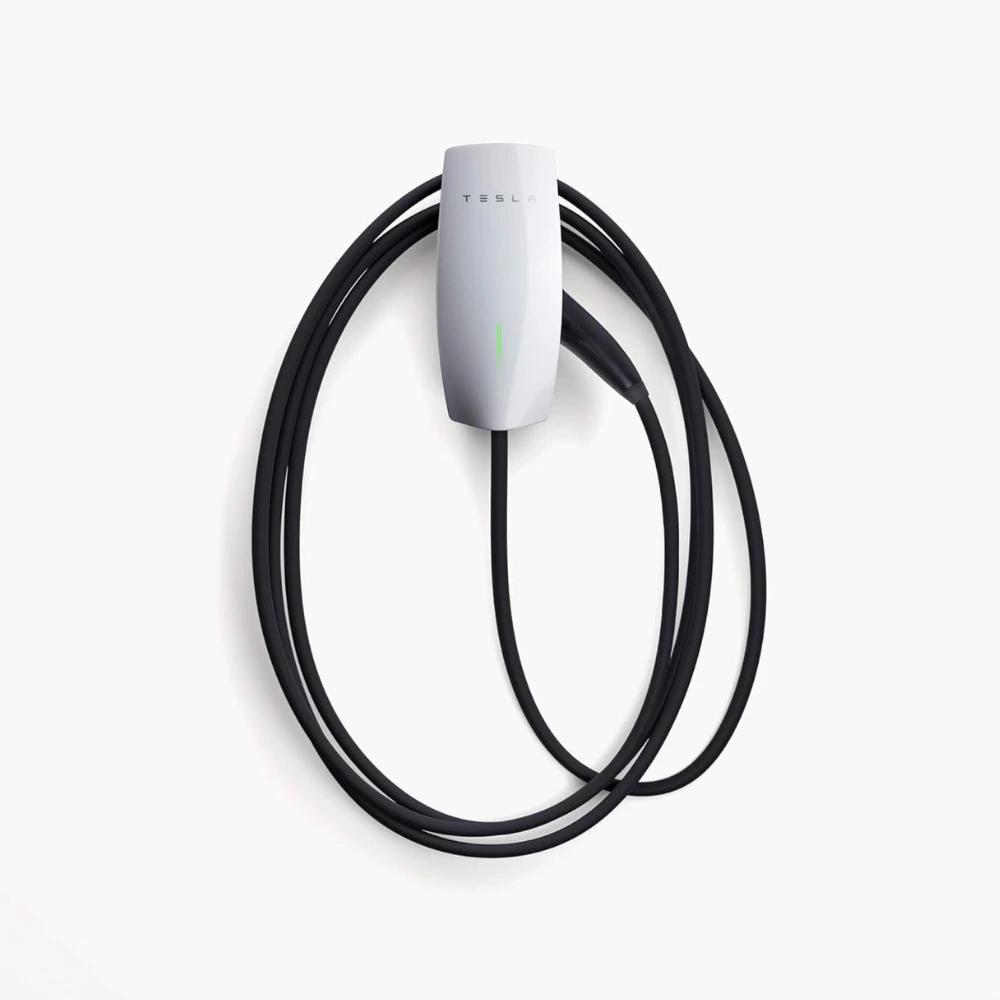
Tesla Wall Connector (Gen 3): simple, powerful, and highly competitive
Why I recommend it: It offers a straightforward experience: plug and charge. In Europe, the Tesla manual for the three-phase version indicates up to 22 kW (32 A at 400 V AC three-phase). Highly recommended for Tesla car owners.
Data:
Max power (EU three-phase): 22 kW (according to the manual).
ConnectorType 2 (EU).
Approach: simplicity + reliability, less “ecosystem of functions” than others.
Real advantages:
If you have a Tesla, the integration is usually very good (and the installation is very standardized).
It's a great option if what you want is power and simplicity without paying for extras you won't use.
Good for homes with three-phase power where you want to get close to 11–22 kW.
When to choose it
You own a Tesla (or plan to own one) and you want a "no-nonsense" charger.
You care a lot about the value for money and you want a well-known and proven team.
Your installation allows for three-phase power and you want to charge faster.
When NOT to choose it
If you want advanced statistics, profiles, more extensive home automation integrations, etc. (Wallbox is usually more complete here).
If you need very specific energy control functions or a solar ecosystem (it depends on the case and how you are going to manage it).

Schneider Electric EVlink Home: robustness and a “serious” electrical approach”
Why is it here? Schneider is an electrical giant, and EVlink Home stands out for reliability and durability. It's the typical choice for those who prioritize "solid hardware + a well-executed installation" over apps or extras. On the downside, it's more expensive.
Data:
Typical versions: 7.4 kW (single-phase) and 11 kW (three-phase) according to the manual/catalog.
ConnectorType 2 (socket or cable depending on version).
Dimensions: approx. 282 × 409 × 148 mm (according to manual).
DC Protection: mentions internal DC 6 mA filter in documentation.
Real advantages:
Very good if you want a charger "for 10 years" and you care about the electrical quality.
Ideal for users who don't need too many smart features, but do need reliability and a brand with an industrial track record.
When to choose it
You prioritize robustness and durability about app/design.
You want a home computer with industrial DNA and clear technical documentation.
It's a particularly good fit if your electrician regularly works with Schneider (panels, protections, etc.).
When NOT to choose it
If you're looking for the best app and a "smart" ecosystem highly focused on the end user (Wallbox usually wins there).
If you absolutely need 22 kW at home: EVlink Home is usually seen in 7.4–11 kW (depending on variants/market), while Tesla/Wallbox makes it easier to get 22 kW.
Practical comparison: which model fits your needs
If you live in a single-family home
Better “all-terrain”: Wallbox Pulsar Plus (by functions + ecosystem).
Better simple/powerful: Tesla Wall Connector (especially with three-phase).
Better robust approachSchneider EVlink Home.
If you park in a communal garage
Two things matter here: regulations + ease of cable installation. In Spain, the general rule (Horizontal Property Law art. 17.5) is that you can install in your private parking space with prior communication to the community, assuming costs and consumption.
In that context:
Wallbox or Schneider are usually liked by installers for their ecosystem/robustness.
Tesla is a great fit if you're looking for simplicity and power.
What to consider before buying a charging station
1) Realistic power (and your installation)
7.4 kW single-phase It is usually sufficient for most (nighttime charging).
11 kW three-phase It's a big leap if your car and your network can handle it.
22 kW It's ideal if you drive a lot of kilometers and want fast charging, but it requires three-phase power and that the car accepts that AC power.
Wallbox Pulsar Plus and Tesla Wall Connector offer variants that reach up to 22 kW (depending on configuration/version).
2) Dynamic power management (to prevent "the circuit breakers from tripping")
If you turn on the oven, water heater, and air conditioning at home, and at the same time the car is under heavy load, you can exceed your contracted power limit. That's why systems are used. power management / load balancing to avoid triggering and optimize the fixed term.
3) Fixed cable vs socket
Fixed cable: more convenient (just plug it in and you're done).
Take: cleaner if you want to leave the cable stored away or if you change cars/cable.
4) Safety and protections
Look for devices with DC (6 mA) detection and install them with the correct protective devices in the electrical panel (this will be determined by the installer according to regulations and the specific device). The Wallbox Pulsar Plus indicates RDC-DD (AC 30 mA / DC 6 mA) and requires an external RCCB (residual current device) according to local regulations.
EVlink Home also mentions an internal DC 6 mA filter in its documentation.
5) Connectivity and “smart”
Ask yourself honestly:
Are you going to use an app and statistics?
Do you want to schedule times every time?
Are you interested in integration with solar/home automation or is charging at night enough for you?
If “yes”, Wallbox is usually the most complete option.
Advantages of having your own charging point at home
Total comfortYou leave every day with a fully loaded car.
Potential savingsYou can concentrate your charging during off-peak hours.
Less dependence of public chargers (and their availability).
Better planningThe load is integrated into your routine (night/nap/off-peak hours).
Installation and regulations in Spain (the basics you should know)
The charging infrastructure is part of the ITC-BT-52 of the Low Voltage Electrotechnical Regulation; there is an official guide (revision of September 2024) with installation criteria in single-family homes and other scenarios.
In communities of neighbors, article 17.5 of the Horizontal Property Law is interpreted in such a way that, in general, it is sufficient to communicate in advance and assume costs/consumption (always respecting regulations).
(Practical tip: ask your installer to provide you with a written diagram of the wiring and protections, and to adjust the load capacity to what your home can actually handle.)
Aid and taxation: what may be relevant in 2026
This changes frequently, but as of January 2026, the following is being discussed:
MOVES III: the IDAE maintains official information on the program (and its deployment depends on regional calls for proposals).
New plansThere is recent coverage about the Auto+ Plan from January 2026 and its approach to the Moves “waiting list”.
Personal Income Tax DeductionSeveral sources report deductions linked to the installation of a charging point (for example, 15% with limits), but always confirm the requirements in your specific case.
Frequently Asked Questions (FAQ)
7.4 kW or 11 kW for home?
If you leave your car at home overnight and drive normal distances, 7.4 kW is usually sufficient. 11 kW is worthwhile if you have a three-phase power supply and want more headroom (or have several cars).
Is 22 kW worth it?
Yes, if your electrical system and car support it and you really need fast AC charging. Tesla (EU manual) and Wallbox (according to datasheet) offer 22 kW in some variants.
Do I need dynamic power management?
Yes. The penalties for mobile phone and screen use while driving have increased significantly in recent years, coinciding with specific control campaigns.
Share:
Table of contents
More entries



Send a message
 English
  Spanish
  Dutch
Dutch  German
  French
  Portuguese
  Italian
  Greek
Greek  Polish